Sometimes the only thing holding you back isn’t your body — it’s your head.
R
Recognise
R
Relax
R
Reframe
R
Routine
When your body isn’t the problem
You’ve done the training. You’ve put in the hours. You know, logically, that you have the fitness, strength, and skill to do the thing in front of you. And yet, when the moment comes, you freeze. You hesitate. You fail.
Sound familiar? Think of:
- The mountain biker who can handle every technical feature in training, but locks up when they arrive at that one particular drop.
- The gym-goer who’s lifted that weight plenty of times in practice, but on competition day, their legs turn to jelly.
- A person who has been cleared by their physio to put full weight through their recovering knee, but the moment they try to walk without crutches, they can’t stop bracing and limping out of fear.
- A runner who trains alone just fine, but signs up for their first event and goes off far too fast, tightens up, and has to walk.
The culprit isn’t the body. It’s the head.
“Sometimes we are not limited by our bodies. It’s our head that holds us back.”
This is where some basic sports psychology comes in. And the good news? You don’t need to be a professional athlete to benefit from it. The mental skills that help elite performers thrive under pressure can help all of us in sport, in work, in life.
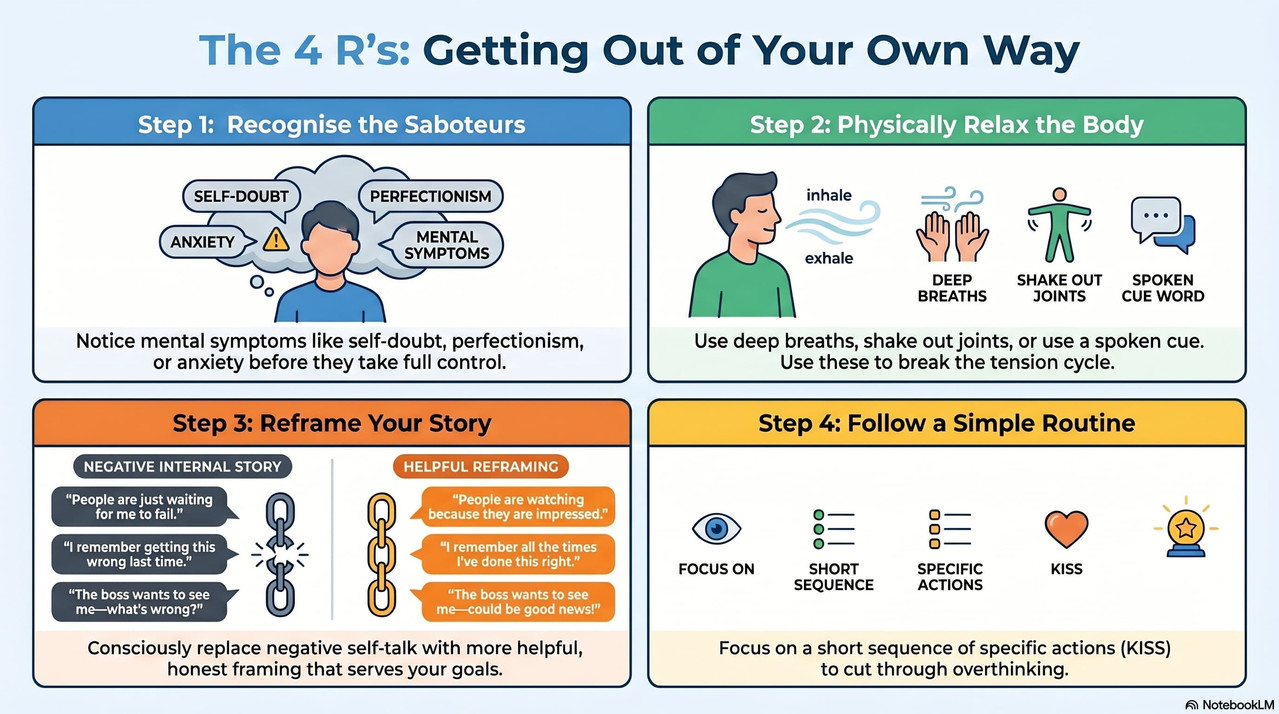
One of the most practical tools is the 4 R’s framework: Recognise, Relax, Reframe, Routine. Let’s walk through each step.
Recognise
Before you can fix a problem, you have to know it exists. The first step is simply learning to notice when your head is getting in the way.
The symptoms vary from person to person, but some common ones include:
- Anxiety – “People are watching. I can’t mess this up. Too much is riding on this.”
- Nerves – “I’ve hurt myself doing this before. Something could go wrong.”
- Self-doubt – “I’ve always failed at this. I’m just not good enough.”
- Overwhelm – “I’ve got a hundred things to remember. I can’t do them all at once.”
- Perfectionism – “If I can’t do this perfectly, I won’t do it at all. I’m just not ready yet.”
Everyone’s version is a little different. The goal is to get to know your personal patterns. To catch those inner voices early, before they take hold.
Perfectionism can be a particularly sneaky one. It often feels like a virtue, because after all, having high standards sounds like a good thing. But when it stops you from attempting something, or makes you abandon something midway because it isn’t going flawlessly, it’s no longer a standard. It’s a barrier.
And the best way to get better at anything? Practice. Deliberately tune into your mental state throughout each day, when you’re stuck in traffic, when your boss sends an unexpected message, when a politician says something racist. The more situations you practise in, the sharper your self-awareness becomes. So when it matters most, you’ll catch it instantly.
Relax
Once you’ve recognised that your head is getting in the way, the next step is to relax both body and mind. The two are far more connected than most people realise.
When stress kicks in, the body tenses up. Muscles contract, hormones surge. The brain picks up on these physical signals and ramps up its own response. Stress makes the body tense; a tense body makes the brain more stressed. It’s a feedback loop that can spiral fast.
Breaking the cycle means interrupting it physically. Two simple techniques that work well:
- Deep breaths – Two or three slow, deliberate breaths, with emphasis on the exhale. This resets breathing patterns that go haywire under pressure.
- Shake it out – Deliberately loosen your joints. Your fingers, wrists, elbows, shoulders, knees, hips. You might be surprised to find your fists have been clenched so tightly your nails were nearly drawing blood.
- Cue word + exhale – Pair a slow, deliberate exhale with a spoken cue word or phrase. The drawn-out lead-in naturally controls your breath, and the word itself becomes a conditioned trigger. The more you practise it, the faster your body learns to respond. For example:
“Aaaaaand… relax.”
Over time this becomes almost automatic. The phrase alone starts to cue the relaxation response, even under real pressure. Sports psychologists call this a relaxation cue word, and it’s a well-established technique.
Again: practice makes the difference.
Practise relaxing in everyday moments. When someone cuts in front of you on the road, when your favourite team loses, when your partner does that thing they always do. Build the habit now, and it’ll be there for you when the pressure is real.
Reframe
Here’s a big reason your head gets in the way in the first place: you’ve told yourself a very negative story about what’s about to happen. This is called negative self-talk and it’s one of the most common performance saboteurs out there.
“Both ‘glass half empty’ and ‘glass half full’ are accurate descriptions.
One helps you. One doesn’t.”
Reframing means consciously replacing that negative internal story with a more honest, more helpful one. It’s not about pretending everything is perfect. It’s about choosing the framing that serves you best right now.
Reframing in practice
| Before | After |
| “Those people are watching, just waiting to see me fail.” | “Those people are watching because they’re genuinely impressed.” |
| “I remember the last time I got this wrong.” | “I remember all the times I’ve done this right.” |
| “The boss has called me in… what have I done wrong?” | “The boss has called me in… could be a bonus!” |
Guess what it tales to get better at reframing? Yup, practice!
The negative voice is loud and fast. The more you consciously practice it in low-stakes situations every day, the more naturally it’ll happen when the stakes are high.
Routine
The final and arguably most important step. Even after recognising, relaxing, and reframing, a jumbled, overthinking mind can still get in the way. The solution? Keep it simple.
You may have heard the acronym KISS: Keep It Simple, Stupid. That’s exactly what Routine is about.
A Routine is a short, rehearsed sequence of specific actions. Not vague intentions or things to avoid.
Why not things to avoid? Because the moment you tell your brain “don’t think about that,” it does exactly the opposite. Tell yourself “don’t slip” and your brain focuses on slipping. Tell yourself “stable footing, look ahead, push through” and it gets to work.
Example Routines
- For a barbell squat – “Tight back. Big breath. Pull myself down.”
- For mountain biking a rock section – “Pedal. Look at the exit. Pedal more.”
- For a single-leg balance – “Soft knees. Eyes on target. Relaxed body.”
Classic everyday examples include:
- Mirror. Signal. Manoeuvre.
- Stop. Look. Listen.
Practise your routine until it’s second nature. Run through it in training, in the warm-up, in quiet moments. The more automatic it becomes, the more reliably it’ll cut through the noise when you actually need it.
Bringing it all together
Sometimes the body is ready. Sometimes it really is the head that’s holding us back. The 4 R’s give us a simple, repeatable process to get out of our own way — in sport, at work, and in life.
And the single biggest thing that makes any of this work?
Practice. Every day, in as many situations as you can.
Recognise
- Notice it
- Catch the anxious voices and doubt before they take hold.
Relax
- Release it
- Break the mind-body stress loop through breath and movement.
Reframe
- Rethink it
- Replace negative self-talk with a more honest, helpful story.
Routine
- Do it
- Follow a simple, rehearsed sequence of actions and go.
Shameless plug
Want help putting this into practice, or with any other aspect of your training and performance? Get in touch, and let’s work on it together.