Many people struggle to take action when they want or need to. They struggle because, when it matters, they freeze, overthink, or react without thinking. The result is the same: they don’t do what they wanted to do, or they do something they later regret.
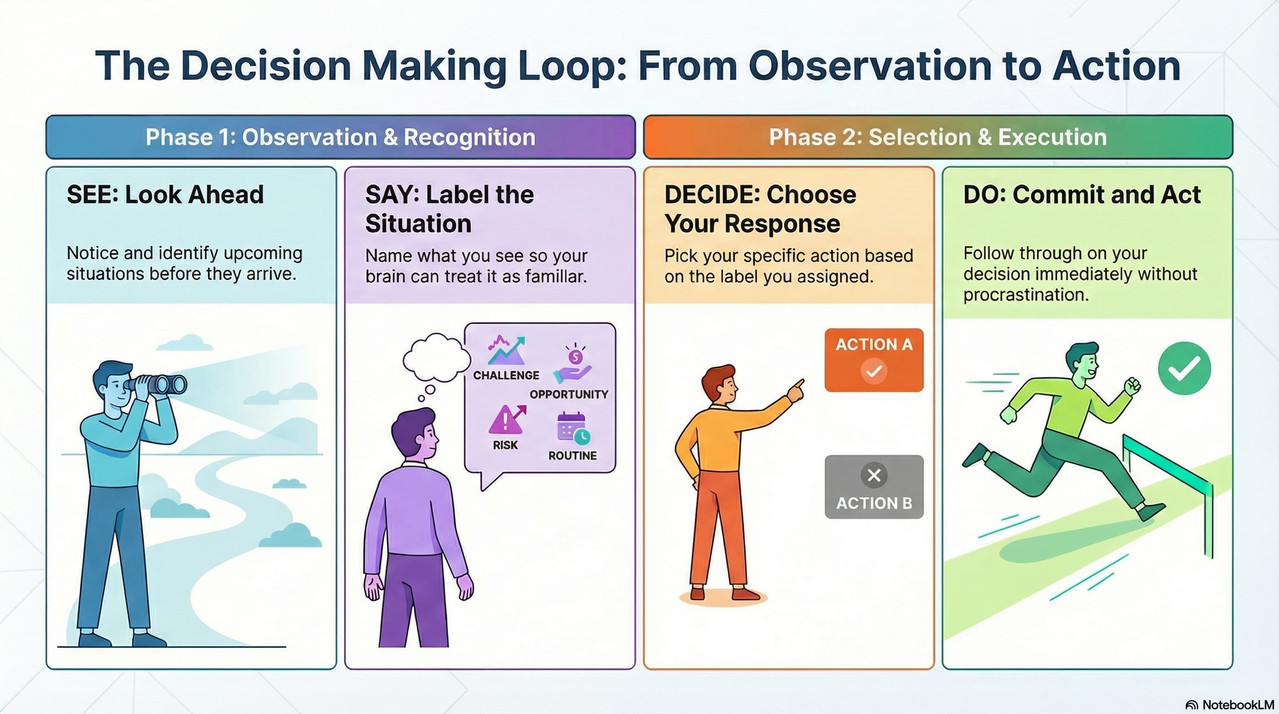
See, Say, Decide, Do is a simple four-step loop that helps you slow down just enough to act well, then speed up until it becomes second nature.
Why it matters
Being able to make good decisions quickly gives you something that’s hard to put a price on: independence. You stop waiting for someone else to tell you what to do. You stop second-guessing yourself into inaction. You start trusting your own instincts, because you’ve given them a structure to work within.
It also helps in difficult situations, the ones where panic or bad habits usually take over. Whether that’s a health challenge, a tough moment in a training session, or a situation where you’ve always defaulted to the wrong choice, this framework gives you a way back in.
The four steps
1. See
Start by looking ahead. Not just at what’s right in front of you, but further, giving yourself time to notice what’s coming before it arrives.
Ask yourself:
- What’s happening here?
- What can I ignore?
- What actually matters?
- What needs a response?
Most people react to things that have already arrived. Seeing well means you’re already thinking about what’s next.
2. Say
Once you’ve noticed something, give it a name. Label it. Put it in a category.
This sounds simple, and it is, but it’s also powerful. When something has a name, your brain treats it as familiar. It stops feeling big and threatening and starts feeling manageable. Something you’ve dealt with before, or at least something close enough to that.
If you ignore it and don’t name it, it tends to grow. Unnamed things have a habit of turning into big,scary things that stop you.
3. Decide
Now choose your response. Not based on panic, not based on habit, but based on the name you’ve just given it, what you’ve done in similar situations before, and what you’ve learned or practiced.
Your options are broader than you think.
- You might face it head on.
- You might choose to avoid it for now.
- You might repeat something that worked before.
- You might pause and gather a little more information.
- You might rehearse a new response before committing.
The point is, you are choosing, not just reacting. You are back in the drivers seat.
4. Do
Act. Commit. Follow through.
This is the step most people quietly skip. They see, they label, they decide, and then they hesitate. They wait for a better moment. They put it off until tomorrow.
Don’t. Once you’ve decided, go. Procrastination at this point doesn’t protect you, it just costs you confidence.
How to practice it
The goal is to run this loop so often that it becomes fluid and natural. But you don’t start at full speed. You start slow, in low-stake situations, and build from there.
Practice Seeing
Start noticing things a little earlier than you normally would. Look ahead, not just at what’s immediately in front of you. Notice what’s relevant. Notice what’s happening around you that you’d normally filter out. This is a skill, and like any skill, it improves with repetition.
Practice Saying
Try running a quiet commentary in your head, or better still, out loud. Imagine you’re a radio sports commentator describing what’s happening to a listener. Over time, you’ll notice that certain words and phrases keep coming up. Those are your categories, your familiar buckets. The bigger that vocabulary gets, the faster and calmer your responses become.
Practice Deciding
Build a small library of responses. Think through some “if this happens, I will do that” scenarios before you’re in them.
- Remember decisions you’ve made before, what worked, what didn’t, and what you’d do differently.
- Learn from your own experience, and from watching how others handle similar situations.
Practice Doing
Start with small, low-stake moments. Practice being decisive. Practice starting things now rather than later. Get familiar with the feeling of committing to something and following through, because that feeling is what you’re trying to make normal.
Ready to give it a go?
See, Say, Decide, Do is something I use with clients across a wide range of situations, from building better habits around food and exercise, to managing physical challenges, to simply getting unstuck from patterns that have been holding them back for years.
If you’d like to explore how it could work for you, I’d love to help. Get in touch and we can have a conversation about where you are, where you want to be, and how to start closing that gap.