Two people can look at exactly the same situation and walk away with completely different interpretations.
One person sees a glass half full. They think about what’s still there, what’s still possible. The other sees a glass half empty. They focus on what’s gone, what they might miss out on. Same glass. Different stories. Different actions. Different futures.
I know which version I’d rather be living.
I’ve noticed this in my own life. When I’ve told myself negative stories, full of reasons why things won’t work or aren’t worth trying, I’ve stopped trying. My confidence has taken a hit. I’ve performed worse professionally, physically, and mentally.
But when I’ve told myself more positive stories, ones built around possibilities rather than problems, things have genuinely improved. My training has gone better. I’ve been more effective at work. And apparently I’ve been much more pleasant to be around.
I know which version I prefer.
So how do you get there?
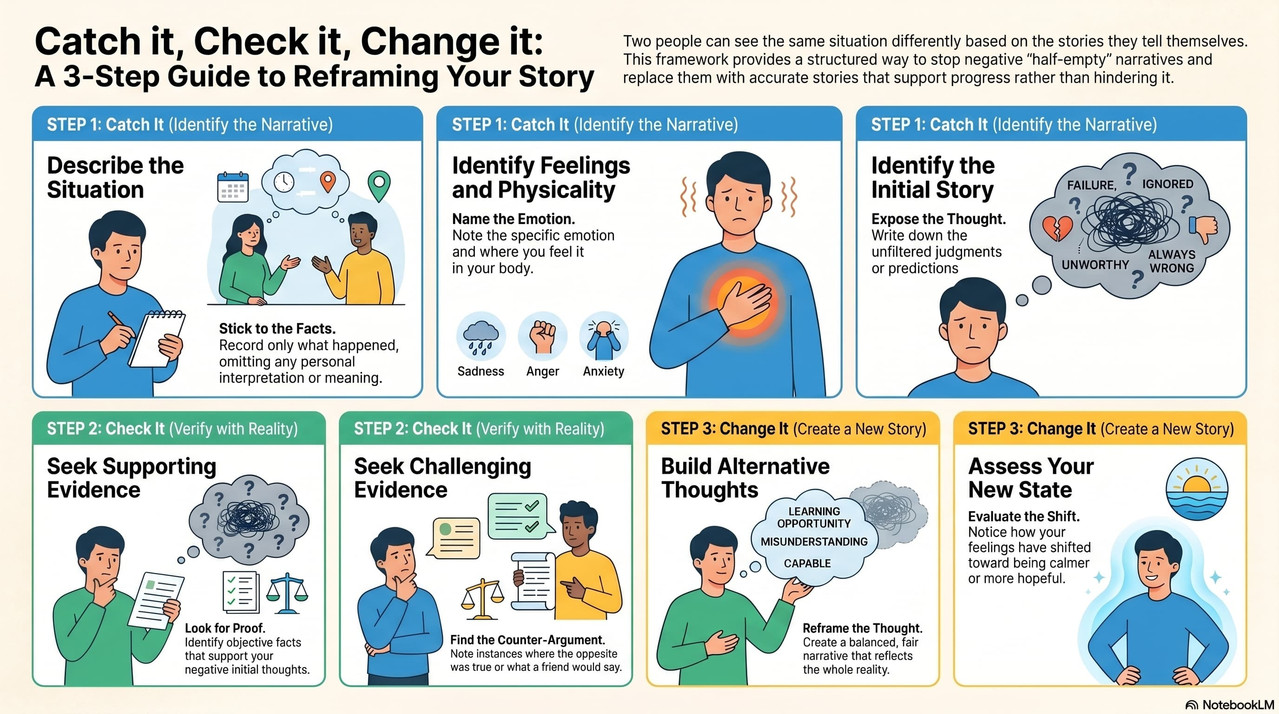
Catch it, Check it, Change it
Before you can change a story, you need to notice you’re telling one. That’s where this simple framework comes in.
Catch it.
Notice when you’re framing a situation or your own actions negatively. Notice the story you’re telling yourself.
Check it.
Ask whether that story is actually justified or fair.
Change it.
Replace it with something more accurate and balanced. A story that helps you move forwards rather than holds you back.
Here’s how to work through it.
Catch it
Start with three questions.
What was the situation? What happened?
Stick to the facts, as if you were describing it to someone who wasn’t there. What actually happened, not what it meant.
For example:
- “I ate a whole packet of biscuits after dinner, even though I’d been eating well all week.”
- “I missed three sessions at the gym this week and barely moved.”
How did this situation make you feel, emotionally and physically?
Where did you feel it in your body? What emotion would you put to that feeling? Try not to write thoughts here. If you find yourself writing “I felt like I’d failed,” that’s a thought. The feeling underneath it might be shame or disappointment. See if you can get to that.
For example:
- “Disgusted with myself, deflated. Heavy feeling in my stomach, slumped shoulders.”
- “Lazy, guilty. A kind of low-level dread sitting in my chest.”
What initial thoughts did those feelings trigger?
What was the story you told yourself? Did it make any predictions about what would happen next, or judgements about what it said about you? Try not to censor it. The thought doesn’t have to be fair or rational. The point is to get it out of your head and into the open.
For example:
- “I’ve ruined everything. I have no self-control and I’ll never be able to stick to anything.”
- “I always do this. I get motivated, start something, then let it fall apart. I’m not someone who exercises.”
Check it
Now test the story against reality.
What evidence supports these initial thoughts?
What actual facts back this up? Not feelings or predictions, just evidence you could point to.
For example:
- “I have slipped up before when trying to change my diet.”
- “I have quit exercise routines before and this isn’t the first week I’ve missed sessions.”
What evidence challenges these initial thoughts?
What would you tell a friend who said this about themselves? Has there been a time when the opposite was true?
For example:
- “I ate well for six out of seven days this week. One difficult evening doesn’t erase that.”
- “I’ve stuck at things before. Last month I hit every session for three weeks straight. This week was unusually busy and I was running on empty.”
Change it
Now build a better story.
What alternative thoughts feel more realistic or fair?
You’re not looking for a positive spin. What’s a more balanced, fairer way to see this? What would a reasonable, calm version of you say?
For example:
- “One bad evening doesn’t cancel a good week. Slipping up occasionally is part of the process, not proof that I’ve failed.”
- “A bad week isn’t a pattern. I’ve shown I can do this. The goal now is to get back on track, not punish myself for slipping.”
How do you feel now, compared to the start?
You don’t have to feel great. Has anything shifted, even slightly?
For example:
- “Less defeated. Still a bit frustrated, but more like a bump in the road than a dead end.”
- “Calmer. A bit more hopeful. Less like I’ve failed and more like I’ve just had a difficult week.”
The short version
The stories we tell ourselves matter more than most of us realise. If you want to move forwards with a little more confidence and a little less self-criticism, try reframing the story.
Catch it. Check it. Change it.
And if you’d like some help doing that when it comes to your training, eating, or health, I’m here. Get in touch with me here and let’s talk.