A practical guide to staying in control when under pressure
Introduction
What is struggling under pressure?
You have probably experienced it at some point. A moment arrives that matters. A movement you need to make, a task you need to perform, a situation that requires you to act. But suddenly your body and mind do the opposite of what you need. You freeze. You tense up. Your thinking goes blank or races out of control.
This struggling under pressure is far more common than people realise. It is not a character flaw, and it is not a sign that you cannot do the thing in front of you. It is simply what happens when the brain interprets a challenge as a threat and responds accordingly.
When the brain senses danger, it triggers a set of automatic responses designed to protect you: muscles tighten, breathing shortens, attention narrows, and the urge to freeze or retreat kicks in. In a genuine emergency, these responses are useful. But in everyday challenges, for example a step into open space, a difficult conversation, a performance that matters, the same response can get in the way.
The brain is not malfunctioning. It is doing exactly what it was built to do. The problem is that it sometimes overreacts. Treating a manageable challenge as if it were a life-threatening emergency.
When can it happen?
Struggling under pressure can happen in almost any situation where the stakes feel high or the challenge feels uncertain. Some common examples include:
- Stepping into open space when you are used to having something to hold on to
- Attempting a physical movement that has caused difficulty or a fall in the past
- Walking into a large, unfamiliar, or crowded environment
- Speaking in public or presenting to a group
- Performing in a sport, music, or other activity when being watched
- Sitting an exam or test under time pressure
- Facing a medical procedure or treatment that causes anxiety
- Starting a new exercise or rehabilitation programme
What these situations have in common is not the activity itself, but the meaning the brain attaches to it. When the brain decides that something matters enough to be dangerous, the freeze response can kick in, even if the body is fully capable of doing the thing.
How can this guide help?
This guide gives you a simple, three-step process: Relax, Focus, Commit. You can use it in the moment when pressure builds and the urge to freeze takes over.
Each step is short, practical, and designed to interrupt the freeze response before it takes hold. You do not need to eliminate the feeling of pressure to use these tools. You do not need to feel calm or confident. You simply need to follow the steps, one at a time, and let your body do what it already knows how to do.
With practice, this process becomes automatic. A reliable routine you can call on whenever you need it.
Important to remember:
Struggling under pressure does not mean you cannot do something. It means your brain is being cautious. These three steps are how you work with your brain, not against it, to get moving again.
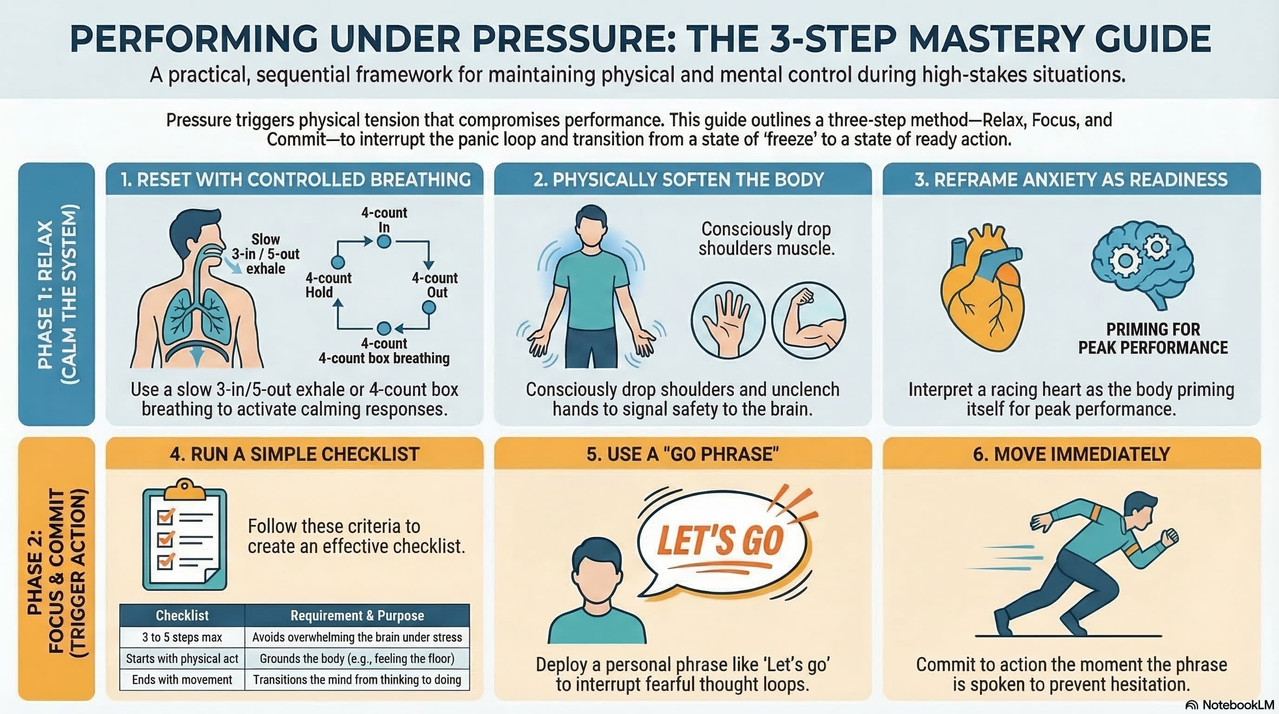
RELAX
Bring the body and mind back to a useful, ready state
Why does relaxing help?
When pressure builds, the body tightens. Shoulders rise, hands grip, breathing shortens, and vision narrows. This physical tension is the body’s way of preparing for a threat. But in practice, tension makes smooth, controlled movement harder, not easier. Tightness is the enemy of performance.
Relaxing does not mean switching off or losing focus. It means bringing the body down from a state of panic to a state of readiness. Primed but not rigid, alert but not overwhelmed.
There is also an important feedback loop at work here. Physical tension and mental tension feed each other. When the body is tight, the brain reads it as confirmation that something is wrong, which increases tension further. Breaking the physical tension first is one of the quickest ways to interrupt this loop. When the body softens, the brain begins to follow.
Ways to relax
Breathing
Breathing is the fastest and most reliable tool for shifting the body’s state. Even a single slow, deliberate breath can make a measurable difference. Try one of these:
- Slow exhale
Breathe in for 3 counts, out for 5. The longer exhale activates the body’s natural calming response. - Box breathing
In for 4 · Hold for 4 · Out for 4 · Hold for 4. Used by surgeons and emergency responders worldwide.
Soften the body
Try these in sequence — each one sends a signal to the brain that you are safe and capable of moving:
- Let your shoulders drop — imagine them melting downwards
- Unclench your hands — let your fingers go loose and soft
- Shake your hands gently at the wrists
- Wiggle your knees slightly — just a small movement is enough
- Shift your weight slowly from one foot to the other
“I am not stuck. I can move. I am okay.”
Look around
When anxious, vision tends to tunnel. You stare at the floor or your destination and nothing else. This actually increases the sense of threat. Instead, deliberately look around the room and take in a few details. This widens your attention and tells your brain that the environment is safe.
Name the feeling
Don’t try to push anxiety away. It tends to push back harder. Instead, name it briefly:
“I notice I’m feeling anxious. That’s okay. My brain is being cautious.”
Naming the feeling reduces its power. You are not denying it, you are choosing not to be controlled by it.
Reframe the situation
How you interpret a situation shapes how your body responds to it. The same physical sensations (a racing heart, heightened alertness) can be read as either threat or readiness. Here are some reframes to practise:
- About your body:
- “My heart is beating faster. That means my body is primed and ready.”
- “This tension is my body taking this seriously. That’s appropriate.”
- “This feeling is uncomfortable, not dangerous.”
- About the situation:
- “I have done this before. My body knows what to do.”
- “The floor is solid. It has been solid every time.”
- “I am more capable than my fear gives me credit for.”
- About the freeze:
- “Freezing is just my brain being cautious. I can thank it and choose to move anyway.”
- “This feeling will pass. It always does.”
The ‘what is actually true?’ check
When the brain spirals, it tends to leap to worst-case scenarios. Interrupt this by asking yourself two simple questions:
- “What is my brain telling me right now? (e.g. ‘I’m going to fall’)”
- “What is actually true right now? (e.g. ‘I am standing. My feet are on the floor. I am okay.’)”
This grounds you in present reality, rather than your brain’s fearful prediction of what might happen.
Last time I Struggled Under Pressure, what could I have done?
- How to control my breathing:
- How to relax my body:
- How could I have reframed my thoughts:
FOCUS
Cut the noise — tune in to your simple action checklist
Why does focusing on a checklist help?
Under pressure, the mind races. What if I fall? What do people think? I can’t do this. I should have prepared more. This internal noise is exhausting and crucially, it crowds out the thinking you actually need to do.
The antidote is not to think harder. It is to think less and more deliberately. When you focus on a short, simple, physical checklist of actions, you give the brain exactly one job to do. Everything else falls away.
A good checklist works because it is familiar, manageable, and action-oriented. It does not ask you to feel confident, it just asks you to do the next small thing. And then the next. That is all.
What makes a good checklist?
- 3 to 5 steps maximum — the brain cannot process complexity when anxious
- Starts with something immediate and physical (a breath, dropping the shoulders)
- Includes a grounding step (feeling the floor, finding a point to look towards)
- Ends with movement — just the first step, not the whole journey
- Is practised so often it becomes automatic
Example checklists
These are starting points. You will build your own personalised version with your trainer.
Body-first checklist
- Drop the shoulders
- Take one slow breath out
- Feel the floor under my feet
- Pick one spot ahead to look at, not down
- Take one step
Breath-first checklist
- Breathe out slowly
- Unclench the hands
- Look up — find a point ahead
- Say my “go phrase”
- Move
Anchor-and-move checklist
- Find something to look at ahead of me — not the floor
- Feel where I am right now: feet on floor, body upright
- Remind myself: ‘I have done this before’
- Take one step
- Then the next
A checklist only becomes powerful when it is practised. The goal is to repeat it so often (in easy situations, not just difficult ones) that running through it becomes automatic and calming in itself. Think of it like a key in a lock: at first you search for the keyhole, but with practice your hand goes there automatically, even in the dark.
Your focus checklist – write your steps here:
- Step 1 –
- Step 2 –
- Step 3 –
- Step 4 –
- Step 5 –
COMMIT
Your “go phrase” fires the starting pistol — then you go
Why does committing help?
Once you have relaxed the body and run through your checklist, there is only one thing left to do: go.
Waiting longer does not help. The mind will use the extra time to generate more noise, more doubt, and more reasons to delay. Procrastination feels like caution, but it is actually the anxiety feeding itself. Every second spent hesitating is another second for the freeze to tighten its grip.
Committing to action, decisively and without further deliberation, is what breaks the cycle. And the most reliable way to trigger that commitment is with a “go phrase”.
How a “go phrase” works
It acts as a pattern interrupt.
When the mind is stuck in a loop (thinking, worrying, checking, worrying again), a short, firm phrase cuts through it like a sharp knock on a table. It signals to the brain: thinking time is over. Action time has started. It is a gear change, not a motivation speech.
It works because of practice.
On its own, a phrase is just words. But when you practise saying it and then immediately moving, over and over in safe, easy situations, the brain begins to wire the two together. Eventually, saying the phrase automatically triggers the movement. It becomes a conditioned response, like a starting pistol at a race. The more you practise it in safe situations, the more powerful it becomes when pressure is high.
Examples of go phrases
Your go phrase should feel natural and personal to you. It can be simple and practical, or slightly energising. Whatever suits your personality. Some examples:
- “Here we go.”
- “I’ve got this.”
- “Let’s go.”
- “3, 2, 1 — go.”
- “Ready. Go.”
Ideally, choose it yourself. A phrase you have chosen will feel more natural and more yours. It should feel like it belongs to you, not like something someone else handed you.
Your commitment plan:
- My go phrase is:
- When I will say it:
- What I will do immediately after: